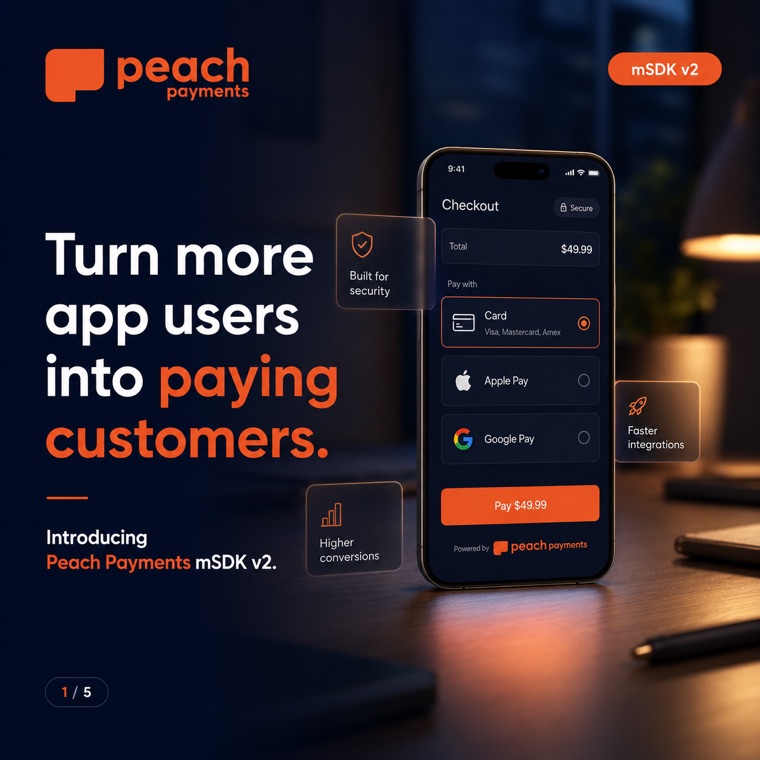
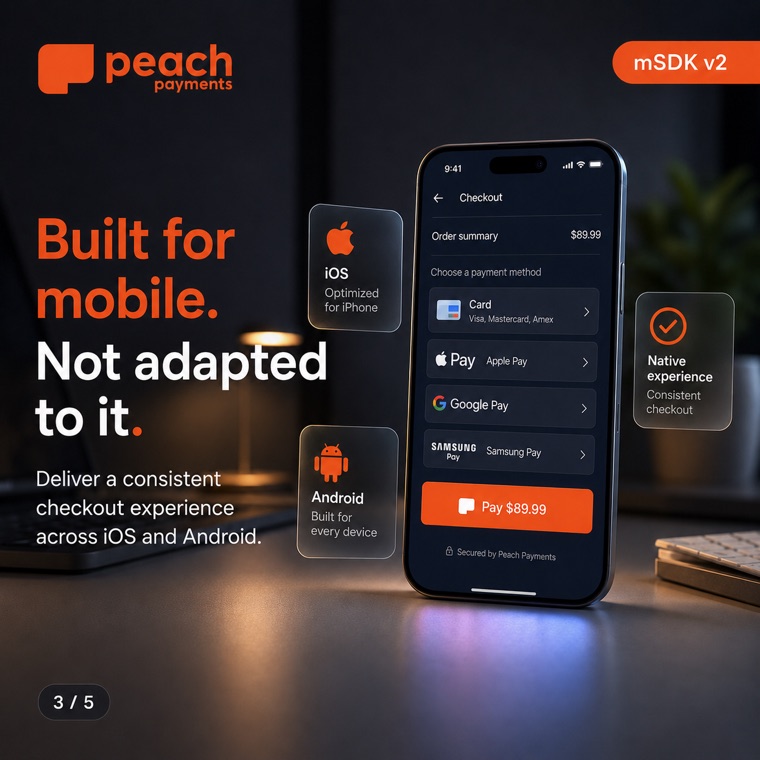
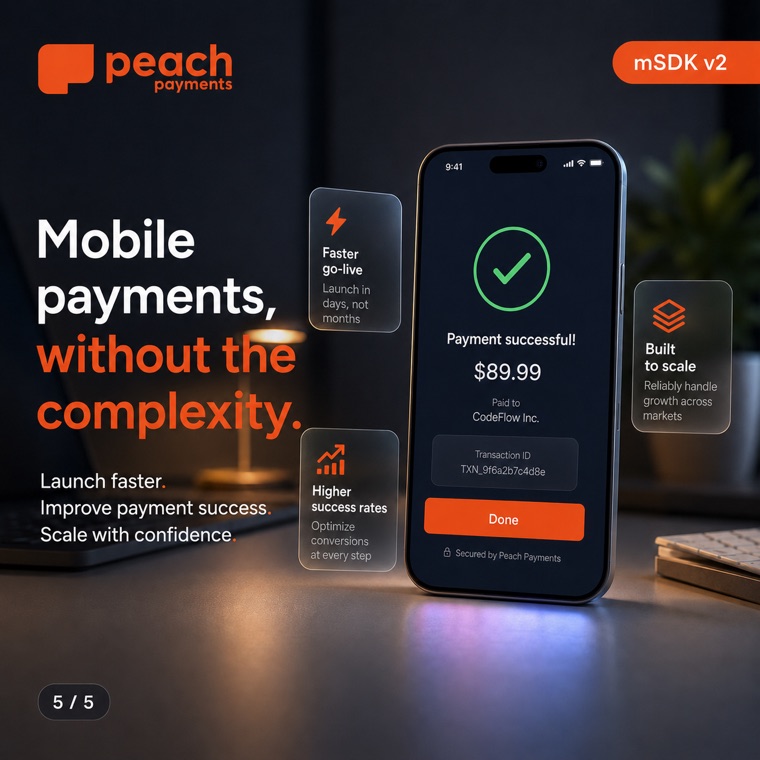
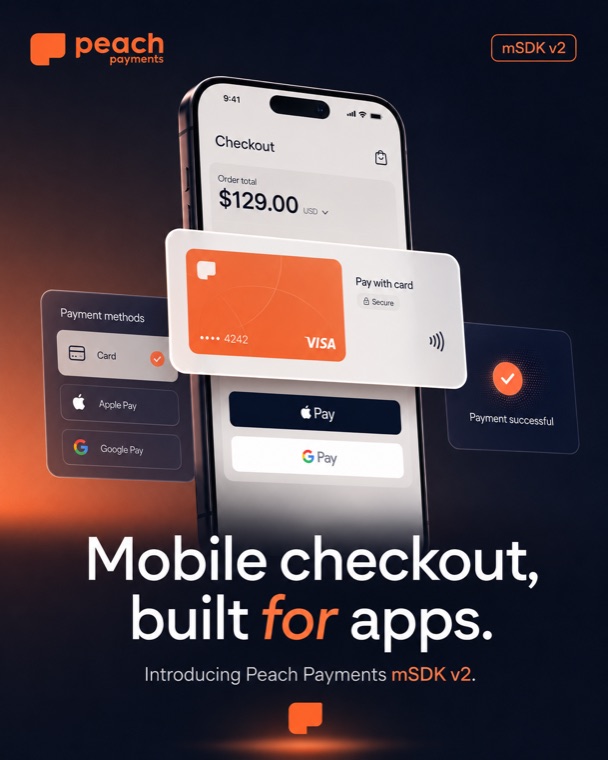
The launch ad campaign for Peach Payments mSDK v2: both carousels running as LinkedIn ads, driving decision-makers and product teams to the demo request page. Four campaigns, one landing page, six weeks, every rand tracked.
LinkedIn is the most expensive social platform, and the only one where we can target by job title. R50 000 buys roughly 550 to 1,100 clicks at South African rates. A demo booking page converting at a typical 2 to 5% lands us at 20 to 35 booked demos.
1 · Turn more app users into paying customers
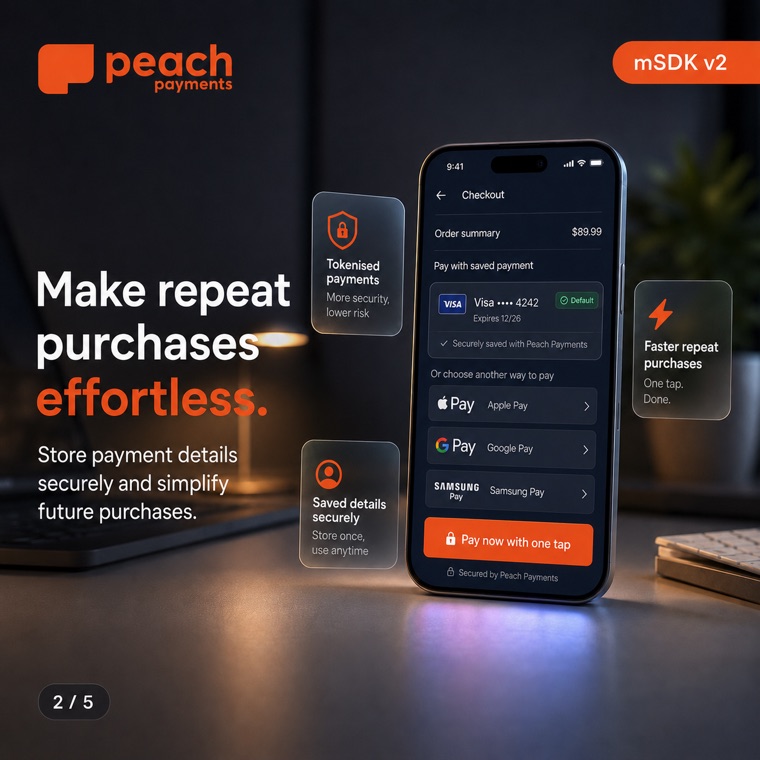
2 · Make repeat purchases effortless
3 · Built for mobile. Not adapted to it.
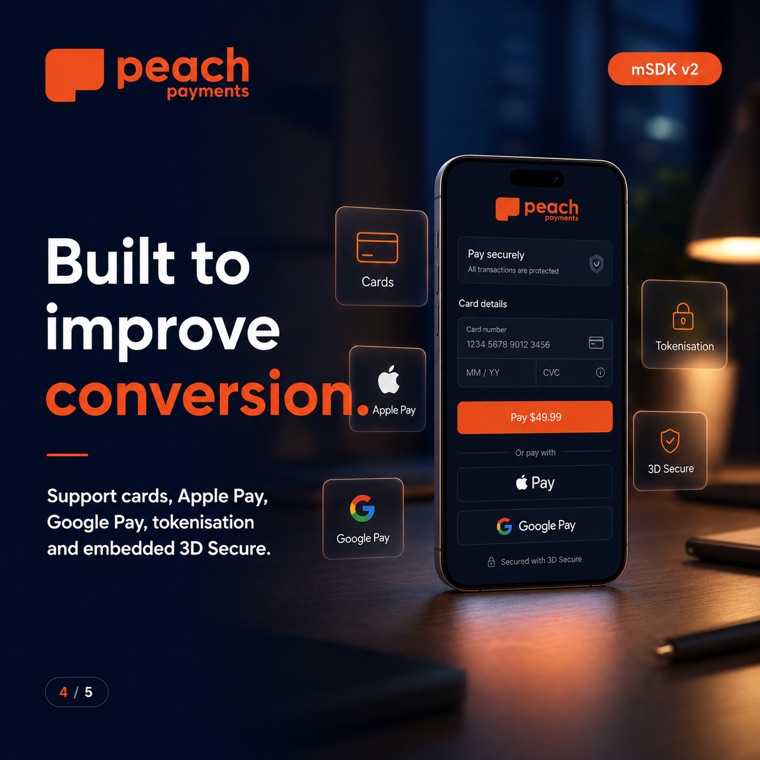
4 · Built to improve conversion
5 · Mobile payments, without the complexity
1 · Mobile checkout, built for appsFix: 4:5 crop → needs 1:1
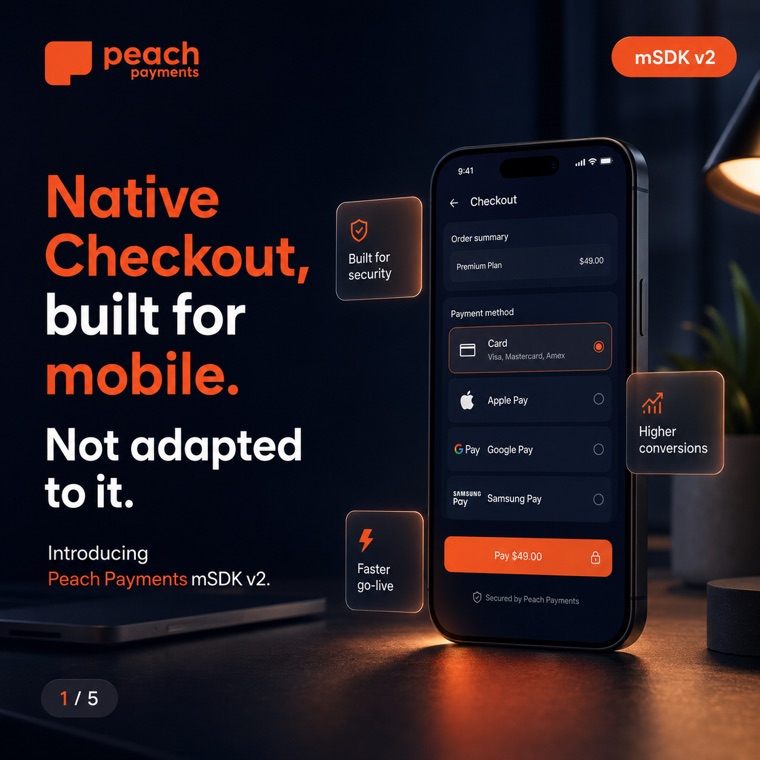
2 · Native Checkout, built for mobileFix: badge says 1/5 → 2/5
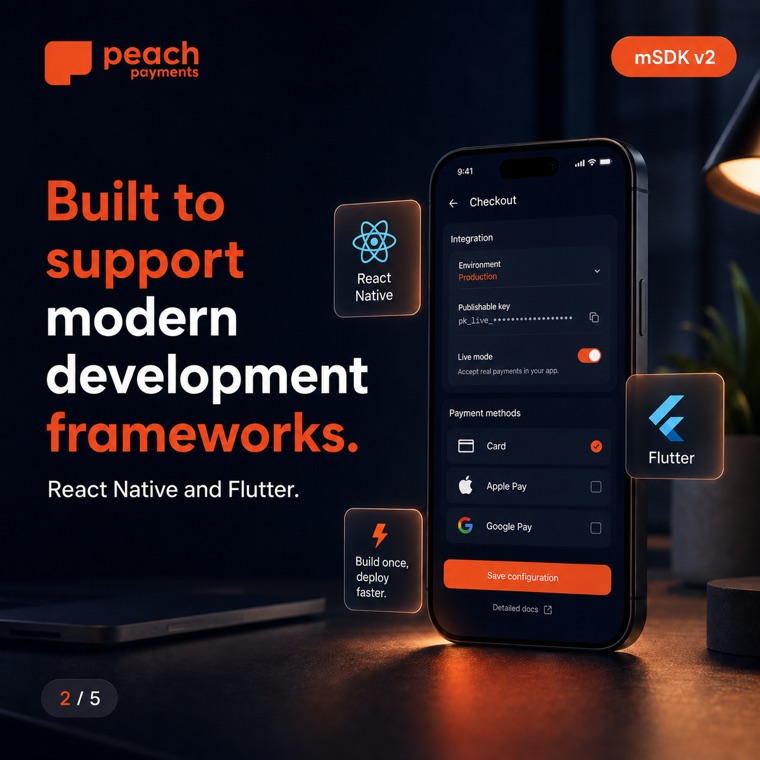
3 · React Native & FlutterFix: badge says 2/5 → 3/5
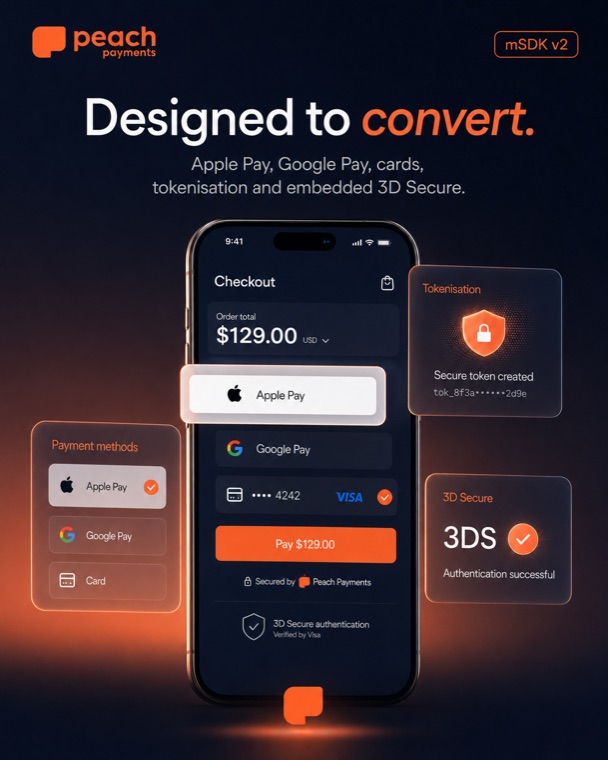
4 · Designed to convertFix: 4:5 crop → needs 1:1 + badge
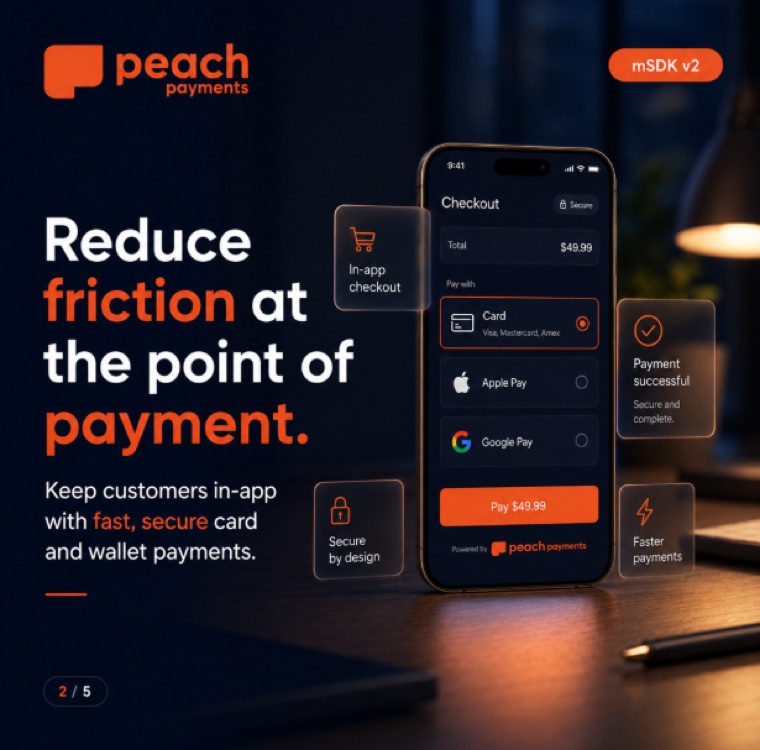
5 · Reduce friction at the point of paymentFix: badge says 2/5 → 5/5
The Nosh native-checkout beat. Google Pay in seconds, payment UI matching the merchant brand.
The wallet top-up beat. React Native and Flutter, Apple Pay and Google Pay from a single API.
The Wander beat. Tokenised repeat purchases and embedded 3D Secure that stays on-brand.
One JS snippet on all of peachpayments.com (Campaign Manager → Analyze → Insight Tag; same install pattern as GA). Unlocks conversion tracking and the website retargeting audiences C4 depends on.
The demo page books a time slot, so there must be a distinct confirmation state, a thank-you URL or event that fires only on a completed booking. If the embedded scheduler can't produce one, we add a thank-you page. This is the single number the whole campaign optimises toward.
Plain UTMs are the "tracking links", no shortener needed. They surface the traffic split in Rybbit and GA4:
?utm_source=linkedin
&utm_medium=paid_social
&utm_campaign=msdk-v2-launch
&utm_content=dm-carousel | dev-carousel | dm-single-1 | retarget-video …
Before any spend: click a UTM link on production, book a test demo, confirm the conversion fires in Campaign Manager and the session shows in Rybbit with the right source. Landing page quick wins while we're there: embed the demo film on the page, move the merchant logos (Samsung, Lacoste, Superbalist…) above the fold, and check mobile load speed, most LinkedIn clicks are mobile.
"Every redirect at checkout costs you paying customers. mSDK v2 keeps them in your app, from tap to payment confirmed."
"One SDK for iOS and Android. React Native and Flutter support, native checkout, tokenisation and embedded 3D Secure built in."
"You've seen what mSDK v2 can do. See it live on your own use case, 30 minutes with our team."
Check daily that money is moving and conversions record, but change nothing for seven days. Every edit resets LinkedIn's learning phase and burns budget.
Two rules, applied without sentiment: pause any ad under 0.30% CTR after ~5,000 impressions, and pause any campaign whose cost per demo passes 3× target (R7 500) with spend to prove it. Frequency above ~4/month per audience means refresh creative or widen the audience.
Launch C4 once the video-viewer and site-visitor pools are big enough. First budget shift: move spend from the weaker cold campaign into the stronger one.
Second shift: the R2 500 reserve plus any loser budget goes to the best cost-per-demo campaign. Check the demographics report, which titles and companies actually clicked sharpens round two.
Spend, clicks, CTR, demos, cost per demo, plus sales feedback on lead quality. That report, not gut feel, decides whether the campaign renews.
Six weeks gives the algorithm time to learn and us two clean optimisation passes. A shorter burst concentrates budget but we learn less for the next campaign.
Boosting a personal mSDK v2 launch post from a Peach founder or exec costs roughly a quarter of standard sponsored content per click, with ~1.7× the CTR. Needs one exec willing to publish. Cheapest reach in the whole plan if we can get it.
LinkedIn's native forms convert ~3× better than landing pages, but deliver a contact to chase instead of a self-booked demo slot. Only reach for this if landing page conversion is under ~2% by week 3, and only if sales commits to same-day follow-up.
Kenya and Mauritius are in-market for Peach but have thinner LinkedIn inventory. Adding them later as a separate ad set keeps the SA baseline readable.